
Digital Registry of Goods Producers: How to Get a Video Stream Link From Your Camera
Starting January 1, 2026, manufacturers in Kazakhstan who want to be included in the digital registry of goods producers and confirm the Kazakhstani origin of their products undergo verification through the e-ondiris system.
The core element of this verification is process cameras, or KTP. The inspector needs to see the production process online: how it's running, whether the equipment is operating, and whether the declared technology is being followed.
It sounds simple: install a camera and provide a link. In practice, this is exactly where most manufacturers run into difficulties.
What the problem is
Cameras at production sites are usually configured for internal surveillance, not for sharing the stream with an external user.
The camera or video recorder has an RTSP link, something like rtsp://192.168.1.42:554/Channel/101 — this is a technical stream address inside the enterprise's local network.
If you send such a link to an inspector, the browser will simply say it can't open it. RTSP is a protocol for video surveillance equipment, not for web pages: browsers and government portals can't read links like this.
Manufacturers solve this problem in different ways, and both of the typical approaches create new risks:
— Grant access through a third-party surveillance service using a login and password: the inspector then has to register in an unfamiliar system, and in the process also gets access to all of the enterprise's cameras, not just the one needed.
— Expose the camera directly to the internet without protection: the stream then becomes accessible not only to the inspector but to anyone who finds the address, which raises a serious information-security concern for the facility.
As a result, the verification process drags on, and the enterprise's IT specialist spends time on setup work that isn't part of their usual duties.
How we solve this
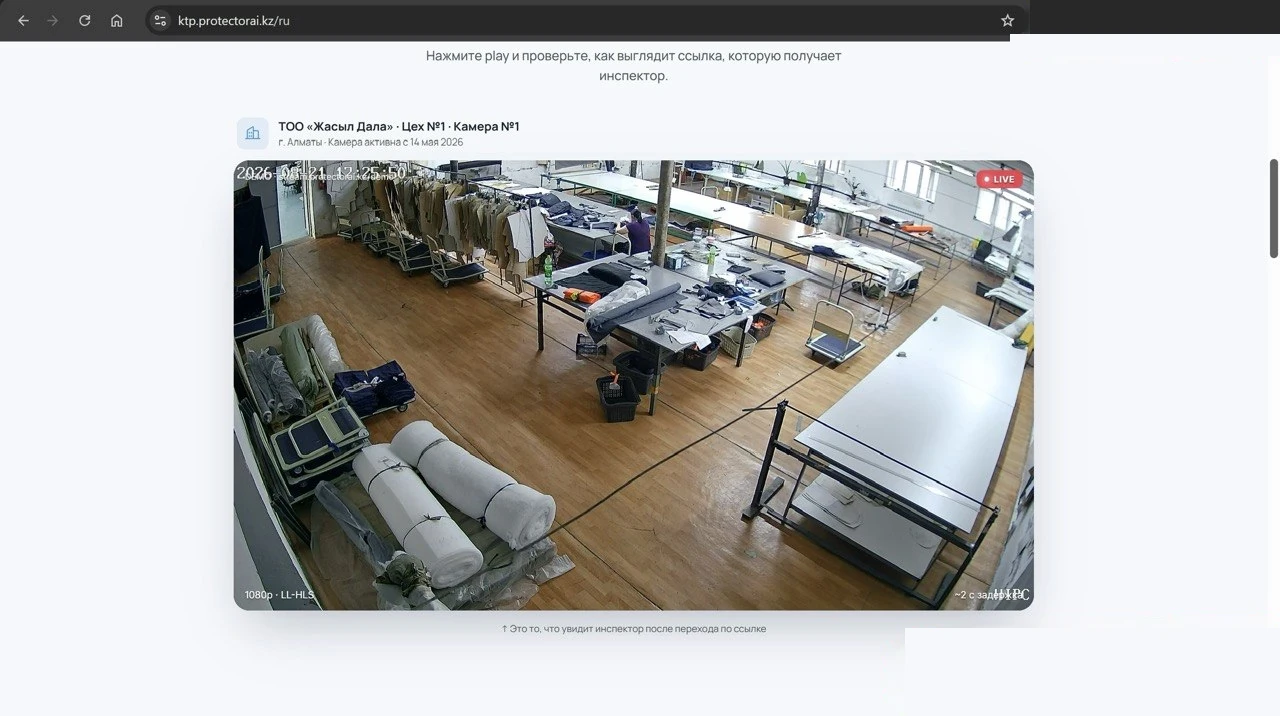
Protector AI has built a separate service — Protector AI Stream (ktp.protectorai.kz) — that takes the RTSP stream from a production camera and turns it into a web link. The inspector opens the link in a browser like any other website, without installing software or logging in, and sees a page with a description of the facility and a video player.
In practice, the difference looks like this:
— Before: rtsp://192.168.1.42:554/Channel/101 — the browser responds, "Couldn't open the link."
— Now: https://ktp.protectorai.kz/[name]/cex-1/live — the browser shows a video player and a description of the facility.
At the same time, only the video stream of that one specific camera is exposed externally. The surveillance settings, logins, and passwords for other cameras remain closed, and confidentiality is preserved — no one from outside gets access to them.
How the connection process works
We handle the setup ourselves — all the enterprise needs to provide is access to the facility itself.
— We study the network: we check where the cameras or video recorder are located, whether the enterprise has a public (white) IP address, and who manages the router.
— We connect the cameras using the appropriate method. If a public IP is available, access is configured directly to the cameras. If there's no public IP, we install our own device on site and set up a secure channel via WireGuard.
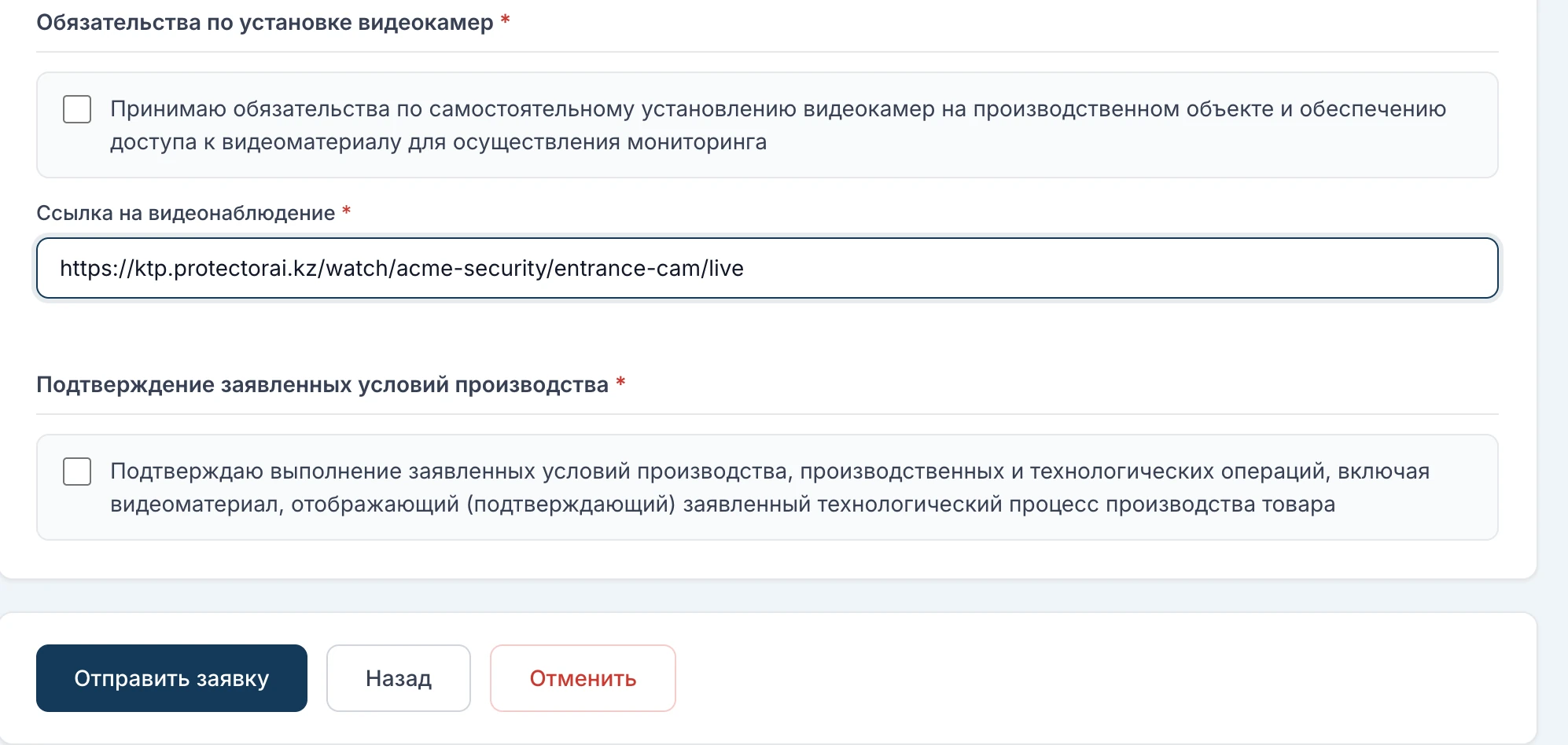
— We provide the links in your personal dashboard. After the connection is set up, public camera links appear in the dashboard — ready to send straight to the inspector.
What the manufacturer gets
— A public camera page that opens without a login and shows only safe, non-sensitive information about the facility.
— Camera status monitoring (online or offline) in the personal dashboard.
— Technical support during setup and throughout ongoing operation.
By default, each camera supports up to 5 simultaneous viewers and 100 broadcast hours per month. These limits can be increased on request.
Why this matters
The purpose of the digital registry of goods producers is to make verifying product origin efficient and transparent, without requiring an inspector to visit every single facility.
But this idea only works if it's genuinely easy for an enterprise to provide a working camera link, instead of spending weeks corresponding with IT contractors.
At Protector AI, we handle exactly this part of the process: we turn the technical challenge of "how to provide access to an RTSP stream" into a ready-made, turnkey solution, so the enterprise can focus on production instead of configuring its own video surveillance.
If your enterprise has production cameras and needs a link for the KTP Registry, submit a request at ktp.protectorai.kz — we'll check the camera and help you set up the connection.