
Video Analytics for Kazakhstani Schools: What AI Monitoring Should Be Able to Do
Surveillance cameras today are installed in nearly every Kazakhstani school — in hallways, at entrances, in the schoolyard. But storing footage is one thing; seeing what's happening in time to respond is another. A person simply cannot watch dozens of screens at once and catch a fight, a conflict, or a stranger by the fence within the first few seconds. That's why schools in Kazakhstan are shifting from passive video surveillance to active AI monitoring that analyzes what's happening on camera and reports the problem itself.
Originally, video surveillance in schools served a single function — recording. Footage was pulled up only after an incident, to figure out who was at fault or to provide material for an inquiry. The camera itself couldn't prevent the incident — it could only film it.
AI video analytics solves this problem: it takes over continuous observation and picks out, from the video stream itself, the situations that require an adult's intervention.
The scale of school video surveillance infrastructure in Kazakhstan is well illustrated by statistics from the Ministry of Internal Affairs: by the start of the school year, more than 283,000 cameras were covering the country's schools, and over 7,000 schools were already connected to operational control centers or police duty units for a faster response to threats. The country has more than eight thousand schools in total — 1.5% more than a year earlier — and the Ministry has declared 2026 the Year of Child Safety. The question is no longer whether a school has a camera, but whether anyone manages to see what it's filming in time.
The Protector AI system analyzes the video stream from already-installed cameras and recognizes situations that signal danger:
— fights and scuffles between students;
— aggressive behavior — sudden movements, shoving, raised fists;
— signs of bullying — one student systematically pressuring another, isolation, groups of children gathering around a conflict;
— unauthorized people appearing on school grounds;
— other unusual situations that break from the school's normal routine.
As soon as the algorithm detects one of these signs, it doesn't postpone the decision — the system generates an alert and instantly sends it to the school's responsible staff.
How it works technically
Protector AI is installed on top of the school's existing video surveillance system — there's no need to replace cameras or lay new infrastructure. The algorithm connects to the video stream and works with it in real time.
— An incident is recognized within roughly 20 seconds of appearing on camera.
— A notification goes to the responsible staff member — to a computer, a mobile app, or a Telegram bot, depending on how the system is configured for that particular school.
— A short video clip (about 8 seconds) is attached to the notification, so staff can assess the situation immediately without digging through the archive.
— Detection parameters are configured for each specific site — the school itself decides which zones and scenarios are its priorities.
This approach removes the main weakness of conventional surveillance — its dependence on whether someone happens to be watching the monitor at that exact moment. Now an algorithm "watches" the footage, and a person steps in only when their attention is actually needed.
Case study: Secondary School No. 20 named after Zhumabek Tashenov, Petropavlovsk
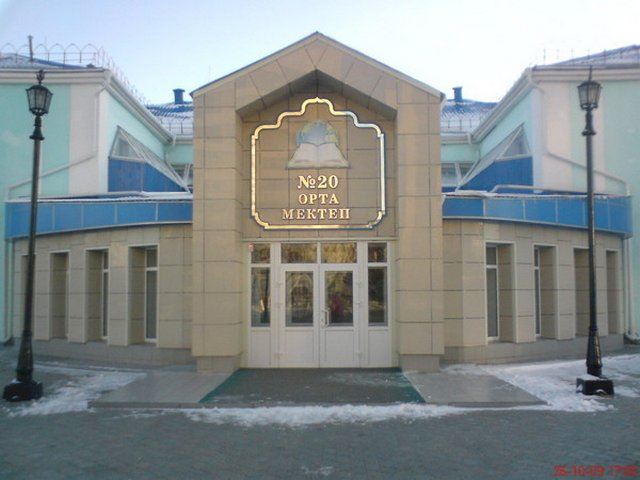
North Kazakhstan Region is one of the areas where schools are shifting to AI video analytics especially actively.
Secondary School No. 20, named after Zhumabek Tashenov, is one of them. The school currently has 207 students, and for five academic years now it has been working to keep the learning environment safe and comfortable for every child.
Before Protector AI, as in many schools, safety was monitored by a single staff member watching the cameras. Akbota Yermekkyzy, deputy director for academic affairs and history teacher at School No. 20, explains:
We have surveillance cameras installed at our school, but usually just one person monitors all of them at once. It's physically impossible to attentively watch every camera at the same time, all the time.
If something happened, the school had to sort it out after the fact — pulling up recordings, rewinding footage, and reconstructing events frame by frame. This was exactly the problem the school hoped to solve with video analytics.
One of the main advantages of Protector AI is that the system detects potentially dangerous situations at the very moment they arise.
The choice in favor of Protector AI was explained by the fact that the solution doesn't require replacing the already-installed cameras, but instead turns the existing surveillance system into a full-fledged safety tool. Protector AI specialists traveled to the school themselves, installed, and configured the system — the administration notes that the process went smoothly.
At first, as usually happens with new technology, it felt unfamiliar to the school staff, and questions came up — how it works, how convenient it is for daily use. But as they worked with the system, attitudes turned fully positive, and the school still stays in touch with Protector AI's specialists whenever questions arise.
The system is especially helpful at moments when a lot of children gather at once — during breaks, or when entering and leaving the building. Such crowds are the hardest to control manually, and Protector AI makes it possible to spot an unusual situation in time and respond.
As for results, the school reports a calm, friendly atmosphere and no recorded incidents of aggression between students. Asked whether she would recommend the system to other schools, Akbota Yermekkyzy answered without hesitation:
Yes, we definitely recommend it. Protector AI helps make our work easier, allows us to spot potentially difficult situations faster, and, most importantly, gives us the chance to prevent them.
And if asked to describe Protector AI in one word, the school chose the very thing the system was installed for — "safety."
What the system gives schools, children, and parents
— Duty staff respond to a conflict not an hour later, but within minutes of it starting;
— The school psychologist and administration get specific, recorded episodes for preventive work, rather than only secondhand complaints;
— The mere fact that the system is running becomes a deterrent — students know that aggressive behavior won't go unnoticed;
— Parents can be confident that their child's safety at school is monitored in practice, not just on paper.
Cameras alone don't make a school safer — what makes it safer is someone (or something) noticing what's happening on camera in time and reacting to it.
Protector AI's AI video analytics takes on this constant, exhausting task for humans and leaves people with what genuinely requires their involvement — decision-making and response.
If a school is considering moving from simple video surveillance to active monitoring, the Protector AI team is ready to show how the system works on the institution's real cameras and to tailor the settings to its specific needs.